Window Farm Grade 1 lesson
Exploring the basic needs of plants
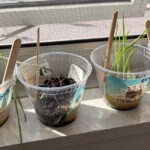
One of Good in Every Grain’s classroom seed kits this year, were the Window Farm kit. This Seed-Starting Window Farm Kit (bilingual) brings plant growth right to your classroom window where students germinate soybeans in “mini-greenhouses” and measure root development. Accompanied by our seed kit, is a free online lesson plan created for the Grade 2 science and technology curriculum, many educators have been using the Window Farm seed kit in a variety of ways (check out some ideas from Ontario educators here).
One thing we have heard, is that many educators have been using this in grade 1 classrooms and we wanted to provide a lesson that explores the basic needs of plants using the Window Farm kits. Read below for more information on this Grade 1 specific lesson.
This framework outlines how to use the Window Farm Kits to meet specific expectations in grade 1 within the Ontario Curriculum, focusing on science, math, art, digital and literacy skills.
LESSON OUTLINE
Estimated time:
30-35 minutes (Initial setup)
Curriculum connection:
Science & Technology: Life Systems – B2: Demonstrate an understanding of the basic needs and characteristics of living things (plants need air, water, light).
Cross-curricular connections:
- Literacy (Writing): 2.3—Use knowledge of sentence structure and language conventions to compose clear and coherent sentences.
- Literacy: Writing descriptive words (adjectives) about the seed and plant. Writing simple “How To” instructions for setting up the farm.
- Health & Wellness (Healthy Eating): C3.1—Identify foods that support healthy growth.
- Health & Wellness: Discussing the nutritional value of the seed/plant (e.g., beans or peas are protein) and its role in a balanced diet.
- Extension – Art (Visual Arts): D1.1—Create two-dimensional works of art to communicate ideas (e.g., visual representation of needs).
- Art: Creating simple banners or collages to visually represent the three basic needs (sun, water, air).
Activity focus
Investigation and Hypothesis – determining what a seed needs to start growing.
Core materials
From Kit: Soybean Seeds, Clear Plastic Baggies, Tape
Classroom Supplies: Paper Towels, Water/Spray bottle, Two extra baggies (for control group), Journal/Paper, Markers/Pencils.
Extension materials
For Art/Health: Rulers (for later observation), Cardstock/Construction paper for banners, Scissors, Glue, Simple craft supplies (e.g., cotton balls for clouds/air).
OUTLINE
Minds On (5mins)
| Review | Review the basic needs of humans (food, water, shelter). Transition to plants. What do plants need to be healthy? (Air, water, light) |
Action (20 mins)
| Setting Up the Experiment | Define the Controlled Condition (The window farm has air, water, and sun) |
| Activity | Create a simple chart in their notebooks titled “Our Seed’s Needs.” They list the three needs (Sun, Water, Air) |
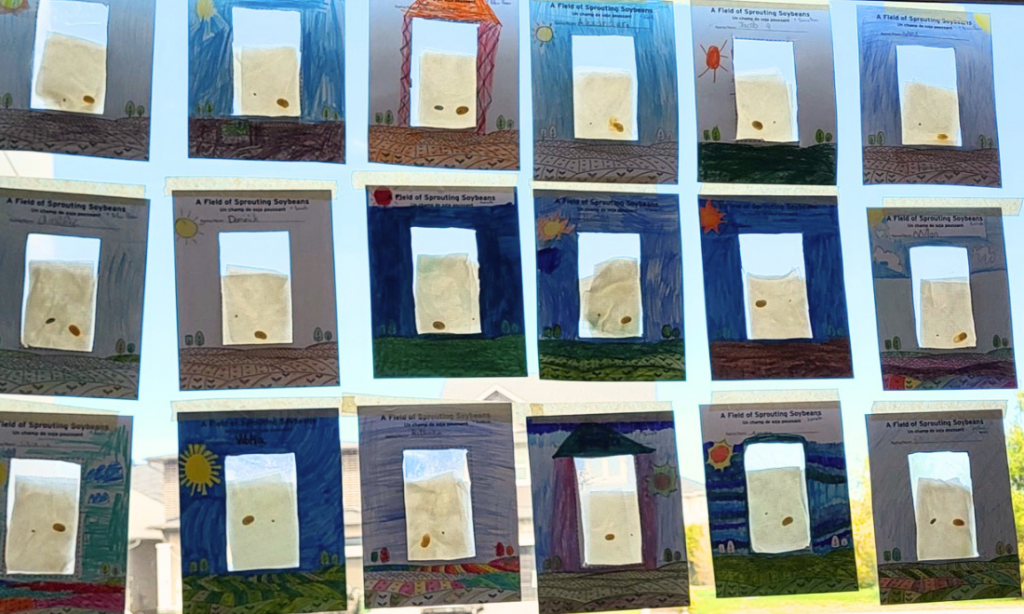
| The Student Set Up | Students set up their baggies (seed + moist paper towel) and tape them to the window. At this time students can colour their window frames. The educator might ask: “What’s missing from the farm scene on the frame from the three needs of a plant?”. Students can then add water and sun to the image and ‘air’ should they wish. |
| The Challenge/Hypothesis | The educator sets up a separate “control group” with the class. Some control groups might include: One baggie in a dark cupboard (no light) One with a dry paper towel (no water) A baggie kept on the other side of the window of the classroom (outside) A paper towel soaked in juice (or other beverage) Ask students to predict which will grow and why. |
Consolidation (5-10 mins)
| Journal Writing | Write a sentence in their journal: “My seed needs _____, _____, and _____ to grow.” |
| Ongoing | Introduce the observation log: “We will check on our seeds every day and draw what we see.” |
EXTENSION: THE “NEEDS OF LIFE” VISUAL BANNER
Time: 40–60 minutes
Extension activity – In Grade 1, students are expected to identify the specific needs of living things. This banner/collage activity serves as a “Visual Summary” of their scientific findings.
Goal: To communicate the “Big Three” needs (Sun, Water, Air) through texture and symbolic art.
Possible materials needed:
| The Need | Suggested Materials |
| Sun (Energy) | Yellow tissue paper, oil pastels (for blending), or bright felt. |
| Water (Hydration) | Blue watercolour wash, “dot” markers, or blue cellophane. |
| Air (Gas) | White crayon (for wax resist), silver glitter glue swirls, or cotton wisps. |
| Other Materials Needed: | Long strip of paper (for the banner) (1 per student)GluePaint brushes and cups of water (depending if watercolour was chosen to represent water) |
Educator instruction (The “Science-Art” Connection)
Before handing out materials, provide explicit instruction on how artists use symbols to represent invisible things (like air).
- The Prompt: “Scientists use diagrams to show how things work. Today, we are artist-scientists. We are going to create a 2D banner that ‘tells’ the story of what our seeds need to survive.”
Materials & Artistic Elements (D1.1 Focus)
To meet the D1.1 standard (communicating ideas through 2D works), encourage students to use different lines, colours, and textures:
| The Need | Artistic Representation (2D) |
| Sun (Energy) | Warm colours (Yellow/Orange) and radiating lines. |
| Water(Hydration) | Fluid shapes or repetitive patterns (droplets). |
| Air (Gas) | Movement lines (swirls) or “invisible” textures. |
Step-by-Step Activity Flow (timings vary depending on needs of the classroom).
| Step 1: The Base (The “Field”) (5 minutes) | Give each student a long strip of construction paper (the “Banner”). At the bottom, they write the Vocabulary Label: “Living things need…” |
| Step 2: Layering the “Needs” (The Collage) (25 – 35 minutes) | Sun: Place the sun at the top corner. Discuss Balance – is the sun big enough to warm the whole field? Water: Add raindrops or a “stream” near the bottom. Discuss Pattern – can we make the rain look like it’s falling in a rhythm? Air: This is the trickiest! Have students draw “wind swirls” using a white crayon, then paint over it with a light blue wash (Wax Resist technique). This visually represents that air is there even if we can’t see it. |
| Step 3: The Subject (The Seed/Plant) (5 minutes) | In the center, students glue a real soybean seed (like the one in their baggie) or a cutout of a sprout. |
| * Extension “Challenge” for High-Achievers (optional) | Ask students to add a Non-Living item to the banner (like a rock or a toy) and explain why the “Needs” (Sun/Water) don’t apply to that object. This reinforces the Grade 1 Science distinction between living and non-living things. |
| Consolidation (10 minutes) | Verbally or in their notebooks, students complete the following sentence: “In my art, I used ____ to show that plants need ____.” |
THE BASIC NEEDS CHECK RUBRIC
| Achievement Criteria | Level 1 | Level 2 | Level 3 | Level 4 |
| Understanding Content (Life Systems: Needs) | Requires significant help. Struggles to name any needs or suggests things like “a sandwich.” | Identifies some needs. Names “Water” or “Sun” but forgets “Air” or “Nutrients” until prompted. | Identifies all basic needs. Explains clearly: “The plant needs sun, water, and air to stay alive.” | Explains interconnections. Describes why each need matters (e.g., “The sun gives it energy to grow”). |
| Scientific Investigation (B1: The Science Log) | Limited recording. Log contains scribbles or unrelated drawings; cannot explain the work. | Basic recording. Draws a simple circle for the seed; lacks detail or labels in the log. | Clear, labeled recording. Draws a realistic seed and sprout; uses simple labels for growth. | Detailed, analytical recording. Noticing “peeling coats” or “tiny roots”; makes accurate predictions. |