Where do grains go? Soybeans

Soybeans are the largest field crop in Ontario and on average, almost 3 million acres are planted each year producing 3.9 million metric tonnes. Did you know that Ontario is also the largest producing province of soybeans in Canada, and that Ontario farmers grow 60% of Canada’s total soybean production?
Did you know? One acre of grain is roughly the same size as 2.5 hockey rinks.
Types of Soybeans
Types of Soybeans
Ontario produces both specialty-grade and crush-grade soybeans. Specialty grade soybeans are grown for specific food end-uses such as soy milk, tofu, natto, miso, soy sauce, and tempeh. These varieties are primarily exported and, in most cases, produced under non-GMO, identity-preserved (IP) systems.
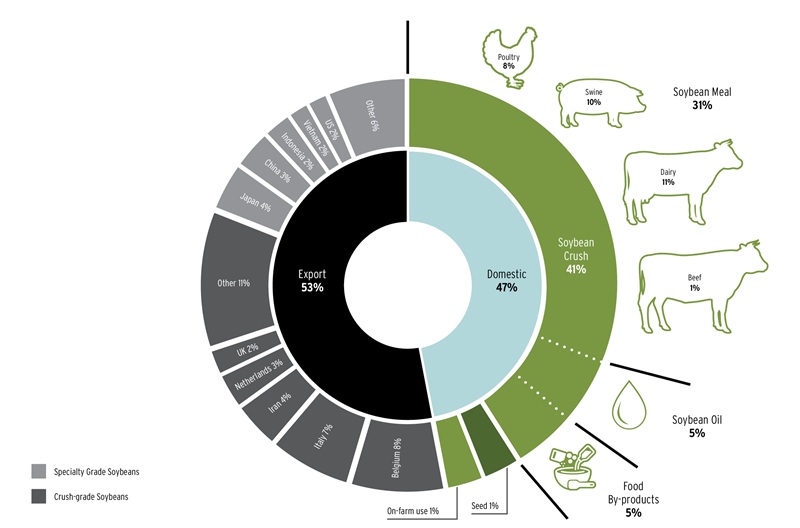
Crush-grade soybeans are when the soybeans are crushed, the oil and proteins extracted, and then this oil and proteins are used to make a variety of food and non-food items. 41% of Ontario soybeans are crushed and of this, 31% is processed into high protein animal feed. The other 10% is processed into soybean oil and other food ingredients.
Mayonnaise, crayons, candles, car parts are made from soybean oil, and many soybean proteins are added into foods, fibres, textiles and even plywood!

Want to try making tofu? Follow this easy recipe for Sriracha Tofu and Coconut Rice.
Get recipe hereExports
Unlike barley, corn, oats, and wheat, the majority of Ontario soybeans are exported; 53% of Ontario’s soybeans destined for international markets. In fact, it is estimated that out of every 5 rows of soybeans grown, 3 rows actually leave Ontario for international markets.
Crush-grade soybeans account for 34% of total export volume, with major destinations including Belgium, Italy, and Iran.
Specialty-grade soybeans make up the remaining 19%, these are largely exported to Asian markets such as Japan, China, Indonesia, and Vietnam.