Getting students talking: practical, STEM-connected oral language strategies for FI classrooms

Article written by Andrea, Instructional Program Lead FSL (HDSB)
Encouraging meaningful student talk in the French Immersion classroom doesn’t have to feel complicated—especially when conversations grow from hands-on learning inspired by everyday farming. Exploring how grains grow, how farmers care for their crops, or how food gets from field to table gives students something real and engaging to talk about. These simple, familiar contexts help students naturally use French to question, plan, experiment, and explain their thinking.
Below are three classroom-ready activities, each grounded in STEM thinking and tailored to primary, junior, and intermediate FI learners. The talk prompts remain the same across all grades—the differentiation comes from the task itself.
These grade bands were created intentionally outside the traditional Primary/Junior/Intermediate divisions. Since the main focus is spoken production, each activity aims to match where students might be with confidence, fluency, and vocabulary at different points in their FI journey.
Any of the activities can be used with any grade when the goal is Oral Production. Here, the STEM tasks simply act as a fun, relevant vehicle to get students talking—about ideas, observations, and the world around them.
Why these activities work
- Authentic learning happens when students explore real-world ideas connected to things they experience every day. When they explore how grains are stored, moved, or turned into the foods they know, students begin to see the bigger system that helps feed Ontario. These simple connections help them understand why each step matters—and how STEM shows up in modern farming.
- French language development is strengthened as students communicate with purpose throughout each task. They must negotiate roles, ask clarifying questions, explain their reasoning, and justify their design choices—all in French. This moves language learning beyond vocabulary memorization and into meaningful, applied communication.
- Scaffolded complexity ensures that each grade band participates in an activity that matches their developmental stage, while still engaging in high-level thinking. Younger students handle simple structures and materials, while older students engage in more complex problem-solving and engineering design. Throughout all levels, oral communication remains central.
- Cross-curricular integration naturally occurs as students explore science concepts, use mathematical reasoning, engage in social studies themes like community and resources, and express their thinking in French. These tasks bring multiple subject areas together into one cohesive learning experience that mirrors multidisciplinary problem-solving in the real world.
Talk moves for all grades
(Use these prompts as table tents, posters, or slide deck prompts.)
1. Exploring the problem
- Qu’est-ce que nous devons faire exactement?
- Quelles sont nos premières idées?
- Comment cela fonctionne-t-il dans la vraie vie?
2. Planning the design
- Je pense que… parce que…
- Et si on essayait… ?
- Peux-tu expliquer ton idée encore une fois?
3. Building & testing
- Regarde—ça ne marche pas. Pourquoi?
- Qu’est-ce qu’on doit changer?
- Je suggère que nous…
- Essayons une autre solution.
4. Reflecting & sharing
- Ce qui a bien fonctionné, c’est…
- Un défi que nous avons rencontré, c’est…
- La prochaine fois, nous pourrions améliorer…
- Notre système ressemble à ceux utilisés dans l’industrie parce que…
Grades 1–2:
Build a mini grain bin
Construire un mini silo à grains
Big idea: Farmers store grains like corn, soybeans, and wheat in grain bins to keep them dry and safe.
Grande idée: Les agriculteurs entreposent des grains comme le maïs, le soja et le blé dans des silos pour les garder au sec et en sécurité.
Task: Students explore how grain bins work, then build a mini grain bin using simple materials such as:
Tâche: Les élèves explorent comment fonctionnent les silos, puis construisent un mini silo à grains à l’aide de matériaux simples (gobelets, petits contenants, ruban, élastiques, riz/lentilles comme grains).
- Plastic cups (gobelets en plastique)
- Small containers (petits contenants)
- Paper, tape, elastic bands (papier, ruban adhésif, élastiques)
- Barley or wheat berries as grain (l’orge or grains de blé entiers comme graines)
Challenge:
Design a container that:
- Holds the most grain,
- Doesn’t leak, and
- Can be easily “emptied” (like unloading grain from grain bins in real life).
Défi:
Créer un contenant qui :
- contient le plus de grains,
- ne fuit pas,
- peut être facilement vidé (comme lorsqu’on décharge du grain de vrais silos)
Students compare which models hold the most and why, encouraging early scientific thinking and oral communication.
Grades 3–5:
Design a grain transport system
Concevoir un système de transport de grains
Big idea: Grains must travel from fields to trucks to farms to elevators to processors.
Grande idée: Les grains voyagent du champ vers les camions, les silos, les trains et les usines de transformation. Chaque étape utilise un système pour déplacer les grains efficacement.
Task: Build a system that moves “grain” (marbles, barley) from Point A to Point B using:
Tâche: En petites équipes, les élèves construisent un système qui déplace des “grains” (billes, l’orge) d’un point A à un point B à l’aide de:
- Paper tubes (tubes en papier)
- Funnels (entonnoirs)
- Cups (tasses)
- String (ficelle)
- Tape (ruban adhésif)
- Cardboard (carton)
Challenge: Create the fastest and most efficient transport pathway with the least grain lost—mirroring real grain-handling systems in Ontario.
Défi: Créer le système le plus rapide et le plus efficace avec le moins de pertes de grains, comme dans l’industrie du grain en Ontario.
Grades 6–8:
Create a grain sorting machine
Créer une machine de tri des grains
Big idea: Grain processors use technology to sort grains by size, weight, and quality.
Grande idée: Les transformateurs de grains utilisent des machines pour trier et nettoyer les grains selon la taille, la masse et la qualité.
Task: In teams, students design a mechanical grain sorter that separates two or more materials (e.g., barley, wheat berries, oatmeal) based on physical properties.
Tâche En équipes, les élèves conçoivent une machine de tri capable de séparer deux ou plusieurs types de grains (ex. L’orge, blé entier, flocons d’avoine) à l’aide de cribles, rampes, entonnoirs et
Provide materials such as:
- Mesh screens (tamis en mailles / grilles métalliques)
- Cardboard (carton)
- Funnels (entonnoirs)
- Tubes (tubes)
- Cups & trays (tassess et plateaux)
- Rubber bands (élastiques)
- Tape & scissors (ruban adhésif et ciseaux)
Challenge:
Create a machine that:
- Sorts at least two “grain types,”
- Operates consistently,
- Can be tested, improved, and demonstrated.
Défi
Créer une machine qui :
- trie efficacement différents “grains”,
- fonctionne de manière constante
- peut être testée, améliorée et présentée à la classe.matériaux recyclés.
Students connect directly to real-world grain-cleaning technologies used in Ontario’s processing and milling industries.
Teacher tip
Consider finishing each activity with a “Grain Expo” where students rotate and present their design to peers using a simple script:
- Voici notre modèle…
- Notre plus grand défi était…
- Nous avons appris que…
Want an easy next step? Try the Grade 3 STEMterprise project in French. It’s designed to support STEM learning, oral language development, and real-world connections—all in one resource.
Learn More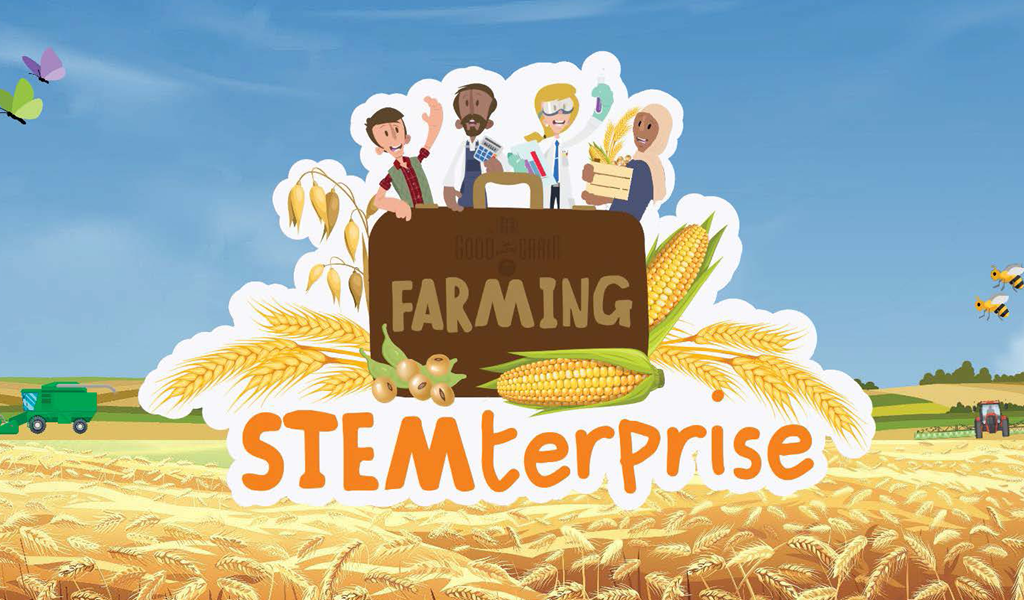
Curriculum connections for each STEM task
The following lists give you an idea of how these activities might touch upon certain curricular expectations. It is not an exhaustive list, but is intended to give you a place to begin.
Grades 1–2 activity: build a mini grain bin
Science & technology (Gr. 1-2)
Grade 1 – Strand D: understanding structures and mechanisms
- D1.2 Identify materials used to build everyday structures.
- D2.2 Investigate how different materials can be used to build a structure that meets a specific need.
- D2.4 Use appropriate tools, materials, and equipment to build a structure.
- D3.1 Identify the purpose of different structures in the environment (e.g., grain bins).
- D3.3 Describe properties of materials and why they are suitable for building and storage.
Grade 2 – Strand C & D: properties of solids and liquids / structures
- C2.3 Investigate how solids can be contained, stored, and moved.
- C2.5 Investigate changes in the state or behaviour of materials (e.g., grains pour like a solid but flow).
- C3.2 Describe characteristics of solids that make them useful for storing goods.
Social studies (optional link)
- Strand A: Students understand needs in communities and how tools/structures support living and working (grain storage as part of food supply).
FSL curriculum expectations (for FI – Grades 1–2)
Oral communication
- A1.1 Identify purposes for listening and speaking during classroom tasks.
- A1.2 Demonstrate understanding of oral messages in structured activities.
- A2.1 Use familiar words and expressions to interact with peers.
- A2.3 Use gestures, tone, and familiar vocabulary to clarify meaning.
- A3.2 Use simple vocabulary and sentence structures to describe actions, needs, and ideas.
Grades 3–5 activity: design a grain transport system
Science & technology (Gr. 3–5)
Grade 3 – Strand D: forces and movement
- D2.2 Investigate how forces (pushes/pulls, gravity) affect movement.
- D2.5 Test and compare the effects of different materials and designs.
- D3.2 Describe how simple machines help move objects (e.g., augers, conveyors).
Grade 4 – Strand D: pulleys & gears
- D2.3 Investigate ways systems transfer motion or materials.
- D3.1 Identify systems used in daily life, including agricultural machinery.
Grade 5 – Strand C & D: matter & energy / systems
- C2.1 Investigate how matter moves through systems
- A2.4 Use scientific inquiry and engineering design processes to solve problems.
- D3.1 Describe how energy and forces help move matter in systems.
Social studies (optional link)
- Strand A (Gr. 4–5): Understanding the role of natural resources (e.g., grains) in communities.
FSL Curriculum expectations (FI 3–5)
Oral communication
- A1.4 Demonstrate understanding of key information from oral texts.
- A2.1 Engage in short, structured interactions with peers.
- A2.2 Ask and answer simple questions to clarify ideas.
- A3.1 Use familiar and some new vocabulary related to STEM, agriculture, and problem-solving.
- A3.2 Produce rehearsed or spontaneous speech to describe their design and justify decisions.
Grades 6–8 activity: create a grain sorting machine
Science & technology (Gr. 6–8)
Grade 6 – Strand D: systems & flight
- D2.1 Use the engineering design process to test and refine systems.
- D2.6 Investigate how forces affect movement within systems (e.g., grain flow).
Grade 7 – Strand C: pure substances & mixtures
- C2.2 Investigate methods for separating mixtures (screening, filtering, sorting).
- C2.4 Use scientific tools to design and test separation techniques.
- C3.3 Describe industrial applications of mixture separation (grain processing).
Grade 8 – Strand D: systems in action
- D2.3 Test how mechanical systems transfer forces and movement.
- D2.6 Investigate efficiency, friction, and design improvements.
- D3.2 Explain how technological systems are used in agriculture and processing.
Social studies (optional link)
- Gr. 7 – Canada’s global connections (role of grain exports).
- Gr. 8 – Economic development & resources (food systems & agriculture).
FSL curriculum expectations (FI 6–8)
Oral communication
A3.4 Present information clearly in French for a specific purpose (design pitch, “Grain Expo”).
A1.4 Interpret detailed information from spoken texts (instructions, demonstrations).
A1.5 Extract key ideas and reformulate them in their own words.
A2.1 Engage in more sustained, structured interactions using academic vocabulary.
A2.3 Apply strategies to negotiate meaning, collaborate, and problem-solve in groups.
A3.2 Use increasingly varied vocabulary and complex sentences to explain processes, justify decisions, and compare designs.